
The Shower Thought Problem: Why Developer Ideas Disappear Before You Can Use Them

You are debugging a problem at 11pm and the solution hits you. Not a vague direction — the actual answer. The exact function that's causing the race condition. The three-line fix.
You're not at your keyboard. You're in bed. You think: I'll remember this.
You won't.
This is the shower thought problem, and it costs developers more time than most people admit. The ideas are real. The context evaporates. What you reconstruct at your desk the next morning is a pale version of what you had in the moment.
Why Developers Lose Ideas
The problem isn't memory. The problem is capture friction.
A good idea has a window. The window is roughly 60-90 seconds of full context before the edges start blurring. To capture it, you need to externalize it before that window closes.
For most developers, capturing a thought requires: unlocking a phone, finding an app, tapping into a text field, typing fast enough to keep up with the idea. That's five steps, each one adding latency. By step three, the specifics are already softening.
The other failure mode: context-switching. If you're in the middle of something else when the idea hits — another focus task, a conversation, falling asleep — any interruption to capture requires ending the current state and entering a new one. Most developers just decide not to bother. The idea gets filed under "I'll think of it again later."
They often don't.
The Cost at Scale
One lost idea is barely noticeable. But developers have good ideas constantly — walking, showering, commuting, running. If you're averaging 3-5 potential captures per day and losing 70% of them to friction, the accumulated cost over months is significant:
- Bug insights that would have saved an hour of debugging
- Architecture decisions reconsidered from scratch that were already solved mentally
- Feature ideas that fade before they become GitHub issues
- Reproduction steps for intermittent bugs that are never quite reconstructed
The individual cost is hard to measure. The pattern is unmistakable if you watch for it.
Voice as the Low-Friction Capture Path
Voice capture eliminates almost all of that friction.
When an idea hits, you don't unlock anything or find an app. You press one key combination — ⌘⇧V — and start talking. Your thought externalizes in real time as you speak. You stop when you're done. The capture window stays open.
This works because speaking is cognitively cheaper than typing in the moment. You don't have to compose — you can talk the way you actually think. "There's a race condition in the auth middleware when two simultaneous requests hit before the session initializes, needs a mutex before the db call, probably in line 47 of the auth handler" is a sentence you can speak in eight seconds. Typing it with the same precision takes longer and requires more working memory on the mechanics of typing.
From Voice to GitHub
Capturing the thought is half the problem. The other half is routing it to where it will actually get acted on.
This is what makes VoiceCommit different from generic voice memo apps. A voice memo is a file you'll half-listen to later, try to reconstruct, and probably not act on in the same way you would have acted on the original thought.
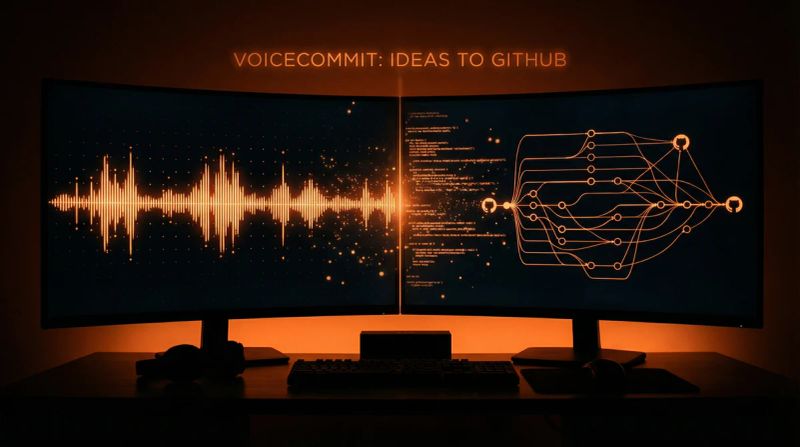
VoiceCommit routes your voice directly to your GitHub repository as a structured issue: title, description, context, appropriate labels. By the time you're back at your desk, the idea isn't in your memory or a voice file — it's in your backlog, formatted correctly, ready to pick up.
The next morning, you don't reconstruct the insight. You just open GitHub.
The Developer Workflow Shift
Developers who use voice capture consistently report a specific change in how they work: they stop dreading the gap between idea and keyboard.
Before, away-from-desk time felt slightly wasteful — good ideas would occur to them but they couldn't do anything with them. After, every idea has a capture path. The commute, the workout, the walk become productive thinking time with a direct connection to the work queue.
The shift isn't about the tool. It's about having a reliable path from insight to action, regardless of where the insight happens.
That path is what VoiceCommit is built to provide.
Related Posts

The Voice to Text Mac App That Lives in Your Menu Bar
Most voice to text Mac apps are built for the wrong person. VoiceCommit is a developer-first voice capture app that lives in your menu bar and routes your thoughts directly to GitHub.

How Voice Input Transformed My Solo Development Workflow
How Voice Input Transformed My Solo Development Workflow
Introducing VoiceCommit: From Ideas to GitHub Issues in Seconds
Introducing VoiceCommit: From Ideas to GitHub Issues in Seconds